
The maximum continuous current per pin is 10 A.
|
The maximum continuous current per pin is 10 A. |
|
The maximum fuse that can be used per pin is 10 A. The fuse serves as short-circuit protection. |
|
The power for sensors, encoders and other equipment should be supplied from the very same unit that the equipment is connected to, to ensure the best performance of the system. No external power (or ground) connections are allowed. |
See section for accurate pin allocation of the connectors when using Epec control unit.
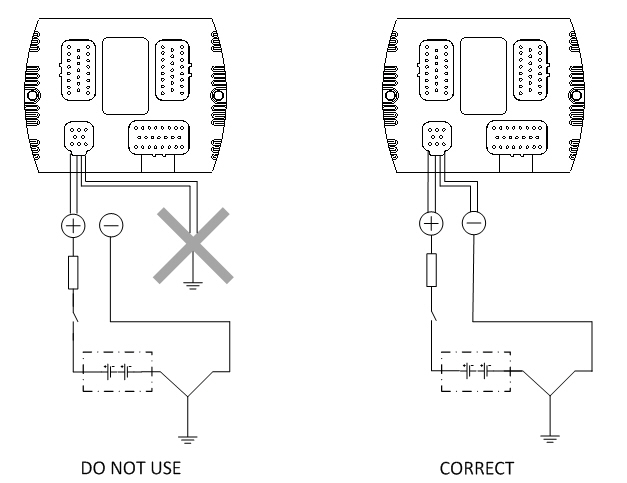
Single point grounding should be used for power supply for all control units.
Epec recommends using doubled power cabling, though in the picture below both power cables are doubled. By using double cables one gets more area for power cables and therefore more current handling capabilities.
Generally the required area of the power cable (Cu) can be determined in following way:
Area = Max Current (A) x Nominal Resistance (Ωm) x Cable Length (m) / Max Voltage Drop (V)
Epec recommends the maximum voltage drop measured against ground potential to be at maximum 2 volts. For extra safety 1 volt should be used as a limit.
Example:
Let’s assume that the machine has a 15 meters boom cable made of copper. There will be estimated 5 amps current, so the recommended cable area would be:
5 A x 0,0172*10-6 Ωm x 15 m / 2 V = 0,7 mm2
Especially in those cases, where the formula above gives greater cable dimensions that can be fitted in AMPSEAL contacts, it is recommended to use doubled power cabling.
If power cables are inside the same cable with CAN bus cables, the maintenance of the system is generally easier.
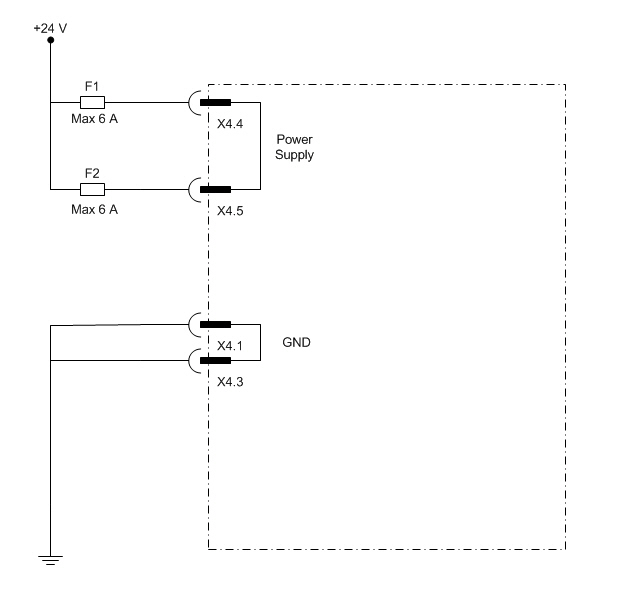
Power supply’s wiring example when max 13 A is needed:
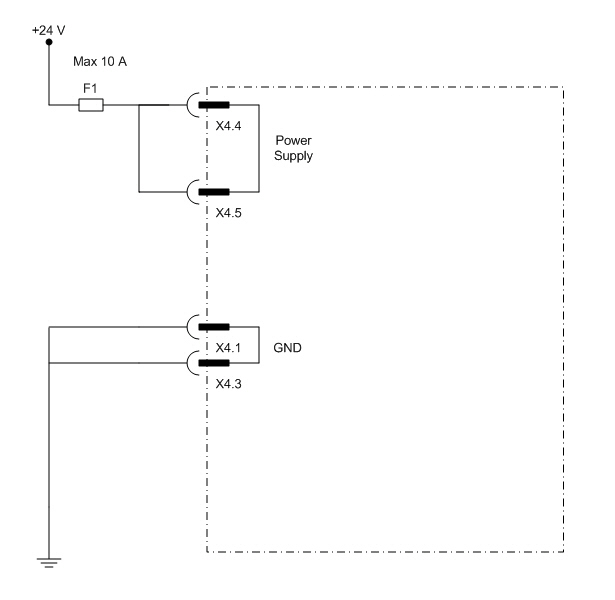
Power supply’s wiring example when max 10 A is needed:
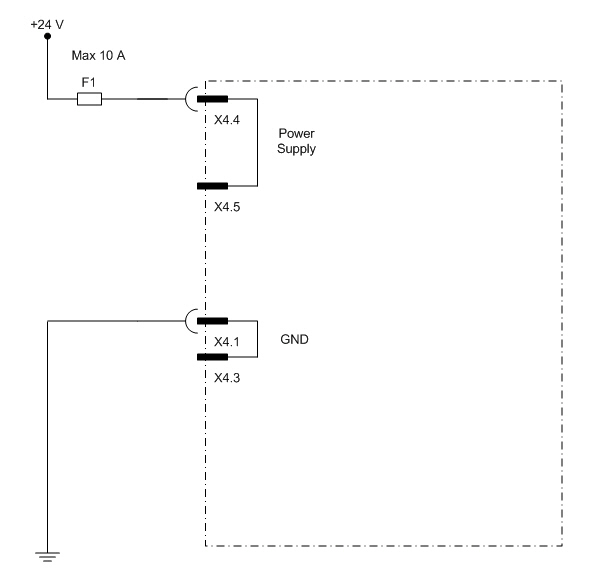
Power supply’s wiring example when max 10 A is needed:
The power for other unit is supplied through the black AMP8 connector.
The following figure shows a wiring example of the power supply. Single point grounding should be used for power supply for all units:
|
In all European Community countries, the emergency stop should be implemented in accordance with standard EN ISO 13850, which complies to the EC Machinery directive 2006/42/EC. In other countries, the emergency stop should be implemented according to local standards and/or to local legislation. |
